If you are hurt on a City of Toronto sidewalk or road, section 42 of the City of Toronto Act, 2006 requires written notice of your claim — with the date, time and location — to be served on or sent by registered mail to the city clerk within 10 days. For snow or ice on a sidewalk, the City is liable only for gross negligence. Lawsuits must generally start within two years.
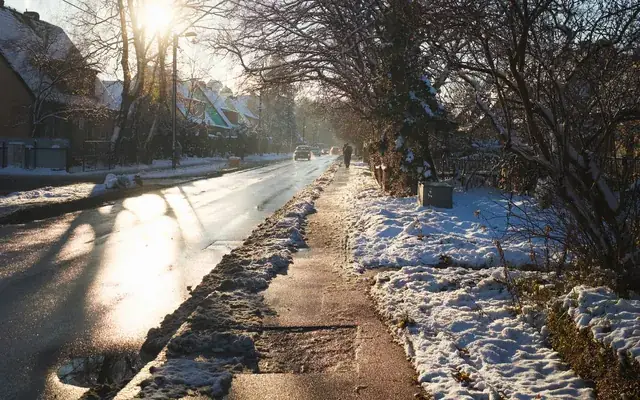
Toronto winters are hard on pedestrians. Freeze-thaw cycles turn slush into black ice overnight, plough ridges block curb cuts, and a sidewalk that looked clear in daylight can be glazed by evening. When a fall on a public sidewalk causes a broken wrist, a hip fracture or a head injury, most people focus — understandably — on getting treatment. Very few realize that the law gives them only 10 days to put the City of Toronto on notice.
This guide explains the 10-day notice rule, what it requires, what happens if you miss it, the special "gross negligence" standard for snow and ice, and how to tell whether the City, a private property owner, or both may be responsible. It is general information, not legal advice — if you've been injured, the safest step is to speak to a lawyer as soon as you can.
The rule: written notice to the city clerk within 10 days
Section 42 of the City of Toronto Act, 2006 requires the City to keep its highways — which includes the sidewalks alongside its streets — in a state of repair that is reasonable in the circumstances. If it fails to do so, it can be liable for the resulting injuries. But subsection 42(6) adds a strict condition: no lawsuit can be brought unless, within 10 days after the injury, written notice of the claim and of the injury, including the date, time and location of the incident, has been served upon or sent by registered mail to the city clerk.
Ten days is counted from the day you were hurt, not from the day you see a doctor or realize the injury is serious. If the sidewalk or road is the joint responsibility of the City and another municipality, notice must go to the clerk of each of them. Outside Toronto, almost exactly the same rule appears in section 44 of the Municipal Act, 2001, so a fall on a municipal sidewalk in Mississauga, Vaughan, Markham, Richmond Hill or Brampton also requires notice to that municipality's clerk within 10 days.
Ice melts and sidewalks get repaired. The 10-day window is meant to let the City investigate the conditions while they still exist. In practice, it means injured people need to act while they are still in pain — which is exactly why so many valid claims are put at risk.
Missed the 10 days? Two exceptions
Missing the deadline does not always end a claim. The Act contains two exceptions:
- Death: failure to give notice is not a bar if the injured person died as a result of the injury (s. 42(7)).
- Reasonable excuse and no prejudice: failure to give notice, or giving insufficient notice, is not a bar if a judge finds there was a reasonable excuse for it and that the City was not prejudiced in its defence (s. 42(8)).
A long hospital stay, a serious head injury or the effects of strong medication can sometimes amount to a reasonable excuse. But the City will usually argue that late notice deprived it of the chance to inspect the scene, and the question is decided case by case. Treat the exceptions as a safety net, not a plan — giving notice on time removes the argument entirely.
Snow and ice: the City is liable only for gross negligence
Falls on snow and ice are treated differently from falls on cracked or uneven pavement. Under subsection 42(5), except in case of gross negligence, the City is not liable for a personal injury caused by snow or ice on a sidewalk. Gross negligence is a higher bar than ordinary carelessness — courts describe it as a very marked departure from the standard of care expected in the circumstances.
Whether a court will find gross negligence depends on the facts. Evidence that tends to matter includes how long the dangerous condition existed, whether the City knew about it (for example through earlier complaints or service requests), the weather in the days before the fall, what the City's winter maintenance crews did and when, and whether the City met the applicable minimum maintenance standards. Building this picture takes time and records, which is another reason to start early.
Sidewalk defects without snow or ice
If you tripped on a heaved slab, a deep crack, a pothole, a broken curb or a missing grate, the ordinary repair standard applies rather than gross negligence. The City can still raise defences under subsection 42(3): that it did not know and could not reasonably have known about the defect, that it took reasonable steps to prevent it, or that minimum maintenance standards applied and were met. Photographs showing the size of the defect and how long it appears to have existed are often decisive.
City sidewalk, private property — or both?
The 10-day rule applies to municipal property. Many winter falls happen elsewhere: on a plaza parking lot, a store entrance, a condominium walkway, an apartment building's steps or the grounds of an office tower. Those are governed by Ontario's Occupiers' Liability Act, which requires owners and occupiers to keep their premises reasonably safe. For injuries caused by snow or ice on private property, section 6.1 of that Act requires written notice to the occupier, or to an independent snow-removal contractor, within 60 days.
Sometimes the answer isn't obvious — a fall at the edge of a sidewalk and a private driveway, or in front of a business that may have its own obligations. When responsibility is unclear, a lawyer will usually send notice to every party that might be responsible, within the shortest applicable deadline.
How to give notice to the City of Toronto
- 1
Write it down as soon as you can
Include your name and contact information, the date and time of the fall, the exact location (street address, nearest intersection, which side of the street, landmarks), what caused the fall, the injuries you suffered, and that you intend to claim damages.
- 2
Address it to the city clerk
The Act requires notice to the city clerk. Toronto City Hall is at 100 Queen Street West, Toronto.
- 3
Serve it or send it by registered mail
Those are the two methods the Act names. Keep the registered-mail receipt or proof of service, and a copy of exactly what you sent.
- 4
Don't wait for complete medical information
The notice doesn't need a full diagnosis — it needs to arrive on time. Details can be developed later.
MAZI LAW can prepare and serve this notice for you, and there is no charge for the consultation.
Evidence that makes or breaks a sidewalk claim
- Photos and video of the exact spot, taken as soon as possible — ideally the same day, with something for scale (a coin, a pen, your shoe).
- The footwear you were wearing, kept unwashed and unaltered.
- Names and phone numbers of witnesses, and anyone who helped you after the fall.
- Weather records for the days before the fall — snowfall, rain and freezing temperatures can show when ice formed.
- Complaints or service requests about the location; residents can report hazards to the City through 311, and those records may later help show what the City knew.
- Medical records from the emergency department, your family doctor and any physiotherapy, starting as soon as possible after the fall.
Deadlines at a glance
- 10 days — written notice to the city clerk for falls on City of Toronto (or other municipal) sidewalks and roads.
- 60 days — written notice to the occupier or snow-removal contractor for snow or ice on private property.
- 2 years — the general limitation period to start a lawsuit under the Limitations Act, 2002.
If your fall happened recently, the first two deadlines may already be running. For a broader look at slip-and-fall claims, see our slip and fall lawyer page, our guide to liability in residential and commercial slip and fall cases, and, for falls west of Toronto, our Mississauga slip and fall page.
Toronto sidewalk falls — FAQs
Yes. Notice is required for claims about the City's failure to keep a sidewalk or road in repair, including snow and ice. In addition, for snow or ice on a sidewalk the City is only liable if it was grossly negligent.
The City of Toronto Act refers to notice being served on, or sent by registered mail to, the city clerk. To avoid any argument about whether notice was properly given, use one of those methods and keep proof.
It depends on who controls that spot. A public sidewalk is usually the City's, while the store's entrance and parking lot belong to the owner or occupier. When it is unclear, notify both — 10 days for the City and, for snow or ice on private property, 60 days for the occupier or its contractor.
A judge may excuse late notice if there was a reasonable excuse and the City was not prejudiced, and a hospital stay can be a reasonable excuse. Give notice as soon as you are able and speak to a lawyer immediately.
Generally two years from the date of the fall, under the Limitations Act, 2002. The notice deadlines are much shorter and separate from that limit.
Sources & legislation
- City of Toronto Act, 2006, S.O. 2006, c. 11, Sched. A — s. 42 — duty to repair, gross negligence for snow and ice on sidewalks (s. 42(5)), 10-day notice (s. 42(6)) and exceptions (s. 42(7)–(8)).
- Municipal Act, 2001, S.O. 2001, c. 25 — s. 44 — the equivalent rules for other Ontario municipalities, including the 10-day notice (s. 44(10)).
- Occupiers' Liability Act, R.S.O. 1990, c. O.2 — s. 6.1 — 60-day written notice for injuries caused by snow or ice on private property.
- Limitations Act, 2002, S.O. 2002, c. 24 — the general two-year limitation period.
- City of Toronto — 311 Toronto — how to report sidewalk hazards to the City.